

Features of a High-Quality Chicken Cutting Machine
A high-quality chicken cutting machine is not defined by speed alone. For a food processor, central kitchen, prepared-food factory, or chain operation, the right machine must help the line produce repeatable portions while supporting safe handling, practical cleaning, and dependable daily operation. As a meat-cutting process planner, I start with the product flow: what enters the machine, which cut is required, how the pieces leave it, and how quickly the team can inspect and clean the working area.
That approach is more useful than comparing a short list of headline specifications. A chicken cutting machine that looks capable on paper can still create bottlenecks if it is difficult to feed, leaves inconsistent pieces, or adds unnecessary cleaning time between production runs. The following features provide a practical evaluation framework.
1. A cutting system suited to the raw material
The first question is not “How many kilograms per hour?” It is whether the chicken cutting machine is suited to the actual material: whole birds, portions, boneless meat, bone-in pieces, chilled product, or product with a different firmness. Blade geometry, feed control, and the way product is guided through the cutting zone all influence the result.
A good system maintains stable cutting action rather than relying on an operator to force material through. Look for a clearly designed product path, guarded cutting components, and guidance that helps keep portions aligned. If the operation needs cubes, strips, segments, or a defined bone-in cut, ask the supplier to demonstrate the intended raw material and target cut. A capable chicken cutting machine should be evaluated on the pieces it produces, not only on an empty-machine demonstration.
2. Consistent portion quality
Consistency affects more than presentation. Even piece size can support downstream cooking, packing, weighing, marinating, and portion control. When assessing a chicken cutting machine, inspect the cut edges, size variation, broken fragments, and the way output accumulates. Uneven pieces may create rework or make the next process less predictable.
Ask practical questions: Can operators adjust the cut setting safely? Is the setting easy to repeat after cleaning or changeover? Does the machine feed smoothly at the expected pace? Does the output match the capacity of the conveyor, scale, tray line, or next worktable? The right chicken cutting machine fits the entire process rather than merely completing one cutting task quickly.
3. Hygienic, accessible construction
Cleanability is a purchasing requirement, not an afterthought. U.S. sanitation guidance for meat and poultry operations emphasizes that food-contact equipment should be constructed to facilitate cleaning and maintenance, and that food-contact surfaces must be cleaned and sanitized as often as necessary to prevent insanitary conditions. Those principles make the physical design of a chicken cutting machine especially important.
Examine whether food-contact areas are accessible for visual inspection and whether guards, guides, trays, and covers can be removed or opened without excessive tools. Smooth, corrosion-resistant surfaces, limited residue traps, manageable drainage, and a layout that avoids hard-to-reach corners all make a real difference during sanitation. A high-quality chicken cutting machine should let the cleaning team see what they need to clean.
- Accessible cutting and feed zones for pre-operational inspection
- Surfaces and joints that are practical to wash and sanitize
- Components designed for safe removal, reassembly, and verification
- A layout that reduces the chance of product residue accumulating unnoticed
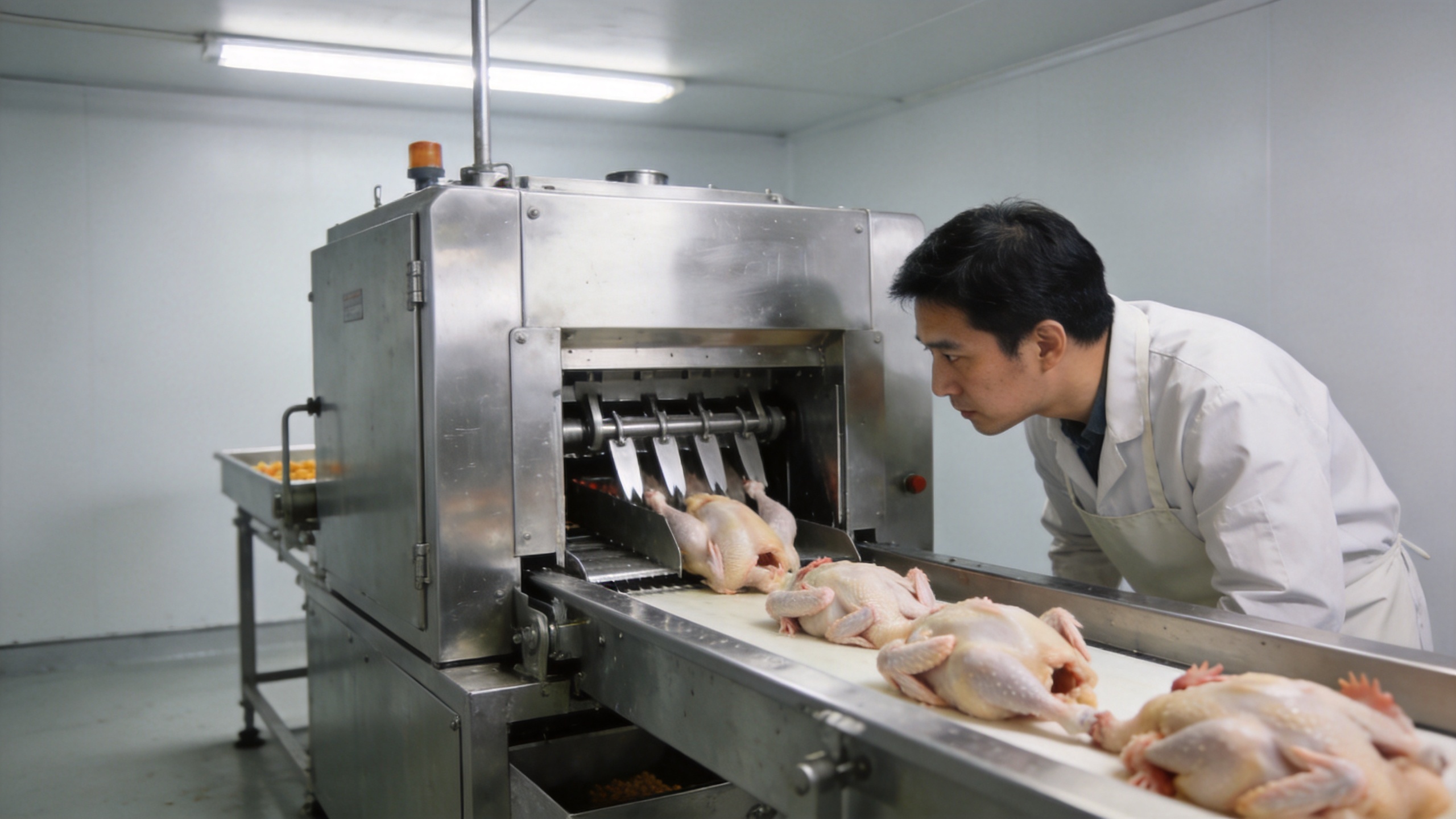
4. Safety features that work with the operator
Guarding and emergency-stop access matter, but good safety design also supports normal work. A well-considered chicken cutting machine separates hands from the cutting zone, provides clear operating controls, and makes routine loading and unloading less awkward. Guards should not encourage unsafe workarounds because they are difficult to use during normal production.
Before purchase, have the intended operators review the feed height, discharge point, control position, and cleaning access. The machine should support training, lockout procedures, and routine blade-related maintenance according to the supplier’s instructions. Safety details should be verified for the specific configuration rather than assumed from a catalog image.
5. Durable components and serviceable design
A high-quality chicken cutting machine needs more than a robust-looking frame. The practical test is whether wear items can be inspected, adjusted, and replaced without creating long interruptions. Ask which components need scheduled attention, how blade condition is monitored, what spare parts are normally held, and what support is available for commissioning and troubleshooting.
Stainless construction may be appropriate in wet food-processing environments, but material alone does not guarantee durability. Pay attention to bearings, seals, drive protection, fasteners, and the shielding of areas exposed to washdown or product debris. A serviceable chicken cutting machine helps a maintenance team prevent small issues from becoming unplanned downtime.
6. Capacity that matches the line
Capacity must be considered as a system value. The output of a chicken cutting machine depends on product type, desired cut, operator loading, and the ability of upstream and downstream stations to keep pace. Buying for the highest theoretical rate can be counterproductive if it creates congestion, excessive handling, or poor portion control.
Instead, map a normal shift: incoming product temperature and format, expected hourly demand, planned changeovers, staffing, collection method, cleaning windows, and downstream capacity. This gives the supplier enough context to recommend a configuration that suits the real process. For facilities moving from manual cutting to semi-automatic or automated handling, it also clarifies where conveyors, collection bins, or additional preparation steps may be required.
7. Proof before commitment
The final feature of a high-quality chicken cutting machine is evidence. Request a trial using representative poultry and ask to observe cut quality, handling, cleaning access, and changeover steps. Document the acceptance criteria before the trial: target portion range, acceptable breakage, operating sequence, sanitation access, safety controls, and support expectations.
Zhaoqing Tengsheng Machinery Co., Ltd serves food-processing, food-chain, central-kitchen, school and factory, and prepared-food operations with food-processing equipment and customized processing-line solutions. For a chicken cutting machine, a process-based discussion of raw material, required cuts, output flow, and site conditions is the soundest way to identify an appropriate configuration.
Conclusion
A high-quality chicken cutting machine combines a suitable cutting path, repeatable results, accessible hygienic construction, operator-centered safety, maintainable components, and line-matched capacity. Evaluate these features with real product and real workflow conditions. That produces a more useful buying decision than focusing on a single speed claim—and it gives your operation a stronger basis for reliable daily processing.