

How to cut poultry safely with a chicken cutting machine?
Safe cutting starts before the first bird reaches the infeed. A chicken cutting machine can make portioning more consistent in a processing room, central kitchen, or prepared-food plant, but it does not replace a trained operator, a documented sanitation program, or the machine-specific instructions supplied by the manufacturer. This guide gives supervisors and line operators a practical way to prepare, run, clean, and restart a chicken cutting machine without treating speed as the only goal.
The useful operating mindset is simple: keep people clear of moving parts, keep raw poultry under the site’s approved hygiene controls, and stop the chicken cutting machine whenever the work moves beyond normal production into clearing, adjustment, cleaning, or service. Local regulations, the equipment manual, and the facility’s safety procedures take priority.
Start with the right work area and a pre-start check
Before operating a chicken cutting machine, assign a trained operator and make sure the surrounding area is dry enough for safe footing, adequately lit, and free of loose tools, packaging, and product buildup. Define where raw poultry enters, where cut pieces leave, and where finished containers are staged. This reduces crossing traffic and helps the operator maintain attention at the point of operation.
Use the pre-start check to confirm that the chicken cutting machine is assembled as intended by its manufacturer. Look for properly fitted guards, secure covers, correctly positioned guides, intact emergency-stop controls, and a clear discharge path. Do not start a chicken cutting machine with a missing, damaged, bypassed, or loosely fitted guard. If a guard will not fit correctly, remove the equipment from service and follow the site’s escalation process.
- Inspect the feed area and cutting zone only while the equipment is stopped and isolated according to your procedure.
- Confirm that collection trays, bins, and tools are clean and positioned so operators do not reach across the cutting path.
- Check that required personal protective equipment is available and compatible with the task; avoid gloves or clothing that could create an entanglement hazard near moving parts.
- Review the day’s cut specification so the chicken cutting machine is not adjusted by trial and error during production.
Prepare poultry for controlled feeding
Consistent input makes a chicken cutting machine easier to operate safely. Sort poultry according to the approved product condition, size range, and cut plan. Remove packaging materials, foreign objects, and any item that could interfere with the intended process. Do not use hands to force an oversized, frozen, tangled, or badly positioned piece into a chicken cutting machine.
Keep the work pace within what the operator can feed and observe safely. A rushed operator may look toward the output bin while placing product at the infeed, which is exactly when hands can drift closer to a hazard. Use the designed pusher, guide, or feed method where provided. If the machine’s configuration does not suit the product condition, pause the operation instead of improvising a workaround.
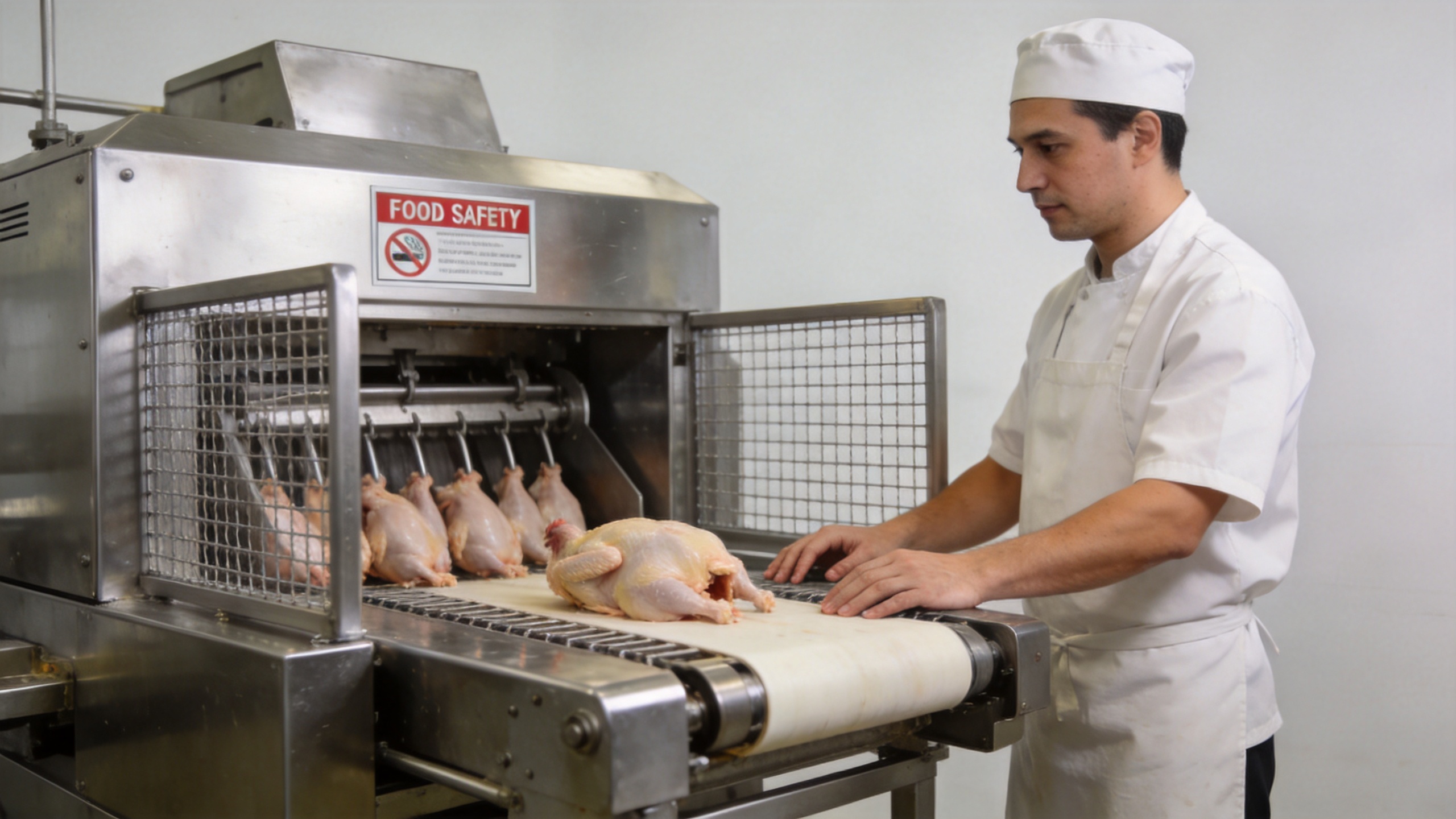
Operate the chicken cutting machine with a clear hand-safety routine
During normal production, stand in the intended operating position and keep hands outside the guarded danger zone. Feed poultry only through the designed opening and use the intended tool or guide rather than reaching into the throat, conveyor, blade area, or discharge. The goal is not merely to avoid an injury; it is to make safe hand placement routine on every cycle of the chicken cutting machine.
Watch the product flow, sound, vibration, and cut quality. An unusual noise, repeated misfeed, unexpected vibration, or change in cut pattern is a reason to stop the chicken cutting machine and investigate through the approved procedure. Do not try to correct a misfeed while the machine is running. Do not reach through a guard or ask a second worker to hold product near a moving cutting area.
Communication matters on a shared line. The person who starts the chicken cutting machine should know that coworkers are clear, and anyone observing an unsafe condition should be able to call for a stop. Keep one person responsible for the immediate operating zone so that loading, unloading, and cleaning tasks do not overlap unpredictably.
Know when normal operation ends
Clearing a jam, changing a component, removing product from a cutting area, adjusting guides, or cleaning inside the machine is not ordinary feeding. Stop the chicken cutting machine, isolate energy, and use the facility’s lockout/tagout procedure whenever the task meets its servicing or maintenance criteria. OSHA’s hazardous-energy principles emphasize isolating energy and verifying de-energization before service work; the exact method must be defined by your site and the equipment documentation.
A useful rule for operators is: if the task requires you to defeat a guard, reach beyond the normal feed point, or place any body part where product normally travels near a cutting mechanism, do not continue as if it were routine operation. Notify the authorized person. This rule protects the operator and prevents a small production interruption from becoming a serious incident.
Clean and reassemble without creating a food-safety or restart hazard
Cleaning a chicken cutting machine is both a hygiene task and a safety task. Follow the site’s approved shutdown, isolation, disassembly, wash, rinse, sanitation, inspection, and reassembly sequence. USDA FSIS sanitation guidance stresses that food-contact surfaces should be effectively washed to remove soils and then sanitized, and that equipment should be reassembled so food-contact surfaces are not contaminated.
Do not spray or wash electrical areas in a way that conflicts with the machine instructions. During reassembly, account for every removable guide, guard, fastener, and tool. A chicken cutting machine should not return to production until the responsible person confirms guards are back in place, the work zone is clear, and the startup check is complete. Record the cleaning and pre-operational check when your quality system requires it.
Use a short restart checklist
- Confirm the cleaning or service task is complete and all authorized workers are clear.
- Verify that guards, covers, guides, and collection equipment are installed correctly.
- Remove tools, parts, and waste from the chicken cutting machine and nearby floor area.
- Follow the site’s energy-restoration procedure; only authorized personnel should remove lockout/tagout devices.
- Run the approved startup check before feeding poultry back into the chicken cutting machine.
- Observe the first pieces for safe flow and acceptable cut results, then resume the planned pace.
Train for repeatable decisions, not just button presses
Good training explains why each step exists. Operators should know the limits of normal operation, how to use emergency stops, whom to notify when a chicken cutting machine behaves unexpectedly, and why sanitation and reassembly checks matter. Supervisors should reinforce that stopping the line for a guard issue, a jam, or an uncertain setup is the correct decision.
For food processors, food chains, central kitchens, schools, factories, and prepared-food plants, a chicken cutting machine should operate as part of a controlled process. Match the equipment, product condition, operator training, sanitation routine, and maintenance plan to the actual line. That disciplined approach helps protect people, supports hygienic poultry handling, and produces more dependable cutting results.
Frequently asked questions
Can an operator clear a jam while the chicken cutting machine is running?
No. Stop the chicken cutting machine and follow the facility’s approved isolation and service procedure. A jam can place hands close to cutting or moving components, so it should not be treated as normal feeding.
What should be checked before restarting after cleaning?
Confirm complete reassembly, correct guard installation, a clear work zone, and the required energy-restoration and startup checks. The chicken cutting machine should only return to production after the responsible person approves the restart.
Does a chicken cutting machine make manual safety procedures unnecessary?
No. The machine supports a controlled cutting process, but safe results still depend on training, guarding, sanitation, supervision, and the manufacturer’s instructions for the specific equipment.