
Role of the vegetable processing machine in modern food prep
Modern food preparation is less about placing one fast machine on the floor and more about keeping every preparation step in rhythm. A vegetable processing machine can support that rhythm by helping teams move raw produce through washing, trimming, cutting, conveying, and handoff to the next operation with greater consistency. For food processors, restaurant chains, central kitchens, school and factory kitchens, and prepared-food plants, its value is usually found in the process around it—not in a headline specification alone.
From a food-processing equipment adviser’s perspective, the first question is not simply “What can this machine cut?” It is whether the raw material, target result, production tempo, cleaning routine, and downstream station can work together. A vegetable processing machine is most useful when it becomes a practical link in that larger preparation flow.
It turns separate preparation tasks into a connected workflow
Vegetable preparation often includes more than slicing. Depending on the menu or product, the work may involve receiving, sorting, washing, draining, trimming, cutting, conveying, and preparing portions for cooking, packing, or further assembly. Post-harvest handling references recognize washing and slicing as important operations for fruit and vegetables; inside a professional kitchen or processing plant, those operations must also fit the day’s labor plan and production schedule.
A vegetable processing machine helps formalize this sequence. It can reduce the stop-start pattern that appears when one person washes produce, another cuts it, and a third waits for material at the next station. That does not mean automation solves every bottleneck. It means the team can design clearer handoffs: where material enters, where excess water is managed, how prepared vegetables leave the station, and who verifies the result.
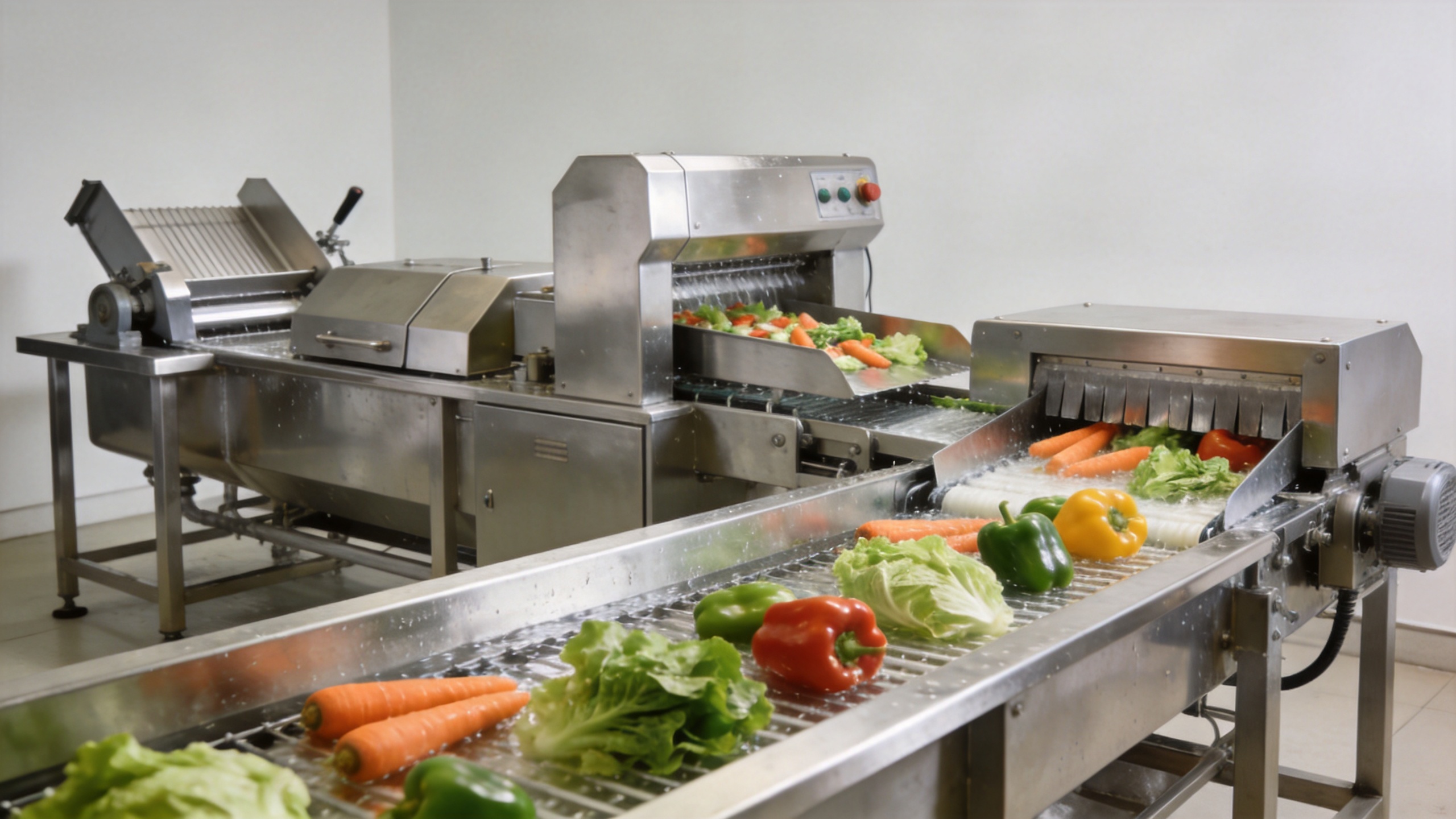
In a central kitchen, for example, a machine may support repeatable preparation before batch cooking. In a school or factory kitchen, it may help a small team prepare common vegetables during a limited pre-service window. In a prepared-food plant, the same principle becomes more detailed because the machine must match the flow to seasoning, packing, chilling, or other downstream steps.
Why material condition matters before machine speed
It is tempting to begin with capacity. Strictly speaking, capacity only becomes meaningful after the material condition is clear. Leafy vegetables, roots, onions, cabbage, and mixed produce can arrive with different sizes, moisture levels, surface debris, firmness, or trimming needs. Those differences can affect feeding, cutting consistency, cleaning requirements, and the time needed between product changes.
For that reason, a vegetable processing machine should be assessed against the real incoming product rather than against a generic vegetable category. Start with questions such as:
- What vegetables will be processed, and how much do their size and condition vary?
- Are they received pre-washed, or does the workflow begin with washing and inspection?
- What cut shape, size, or preparation outcome does the next process require?
- Will the machine run one product for long periods or switch among several ingredients each day?
- Can the incoming and outgoing material move continuously without creating waiting points?
This shift in thinking matters. At first, it is easy to compare blades or nominal output. After mapping the work, the more useful question is whether the selected equipment can accept the actual product consistently and deliver it in a form that the next station can use.
The real role is consistency across preparation steps
A vegetable processing machine can contribute to consistency in several ways. First, it creates a more repeatable preparation action than a purely manual, variable-paced routine. Second, it makes it easier to define a standard work sequence around loading, discharge, collection, and inspection. Third, it gives supervisors a practical point at which to observe whether product condition or flow is changing.
Consistency should not be interpreted as a promise that every vegetable behaves identically. Raw material changes. A better goal is a controllable process: a team notices when incoming produce differs, adjusts the workflow as needed, and avoids passing an unresolved problem downstream. In daily use, this may mean checking feed condition before a run, watching for buildup at discharge, and confirming that containers, conveyors, or receiving tables can keep pace.
That is why modern food preparation benefits from viewing equipment and people together. The machine performs a defined task, while operators handle loading, visual checks, changeovers, cleaning, and response to variation. A well-planned vegetable processing machine supports those actions instead of making them harder.
Cleanability is part of production planning, not an afterthought
Food-processing equipment is not evaluated only while it is running. It must also be inspected, cleaned, and maintained in a way that matches the site’s actual sanitation process. Hygienic-design guidance consistently treats accessible, effectively cleanable equipment as central to controlling contamination risks. Fresh-produce guidance also notes that contaminated wash water, particularly when reused, can become a route for cross-contamination; periodic equipment cleanup and sanitation are therefore operational concerns, not paperwork alone.
For a vegetable processing machine, this leads to practical questions:
- Can operators reach product-contact areas during routine cleaning?
- Are removal, inspection, and reassembly steps clear for the people doing the work?
- How will the site prevent residue or water from becoming a recurring issue between runs?
- Does the production plan allow enough time for cleaning and product changeovers?
Do not treat these points as a claim that any particular configuration meets a specific standard. They are an evaluation framework. The correct cleaning program and verification steps still depend on the equipment configuration, the product, and the facility’s own food-safety controls.
How the machine supports different modern food-prep settings
Central kitchens and food-service chains
These teams often need stable preparation across menus and locations. A vegetable processing machine can help establish a common way to prepare ingredients before distribution or cooking. The important planning task is matching the work cell to the order of operations: receive the product, prepare it, collect it safely, and move it to the next batch without unnecessary handling.
Schools and factory kitchens
These kitchens frequently work within fixed service times and limited preparation windows. A practical machine role is to help staff organize repetitive vegetable preparation while retaining straightforward operating and cleaning routines. Before selecting equipment, verify the daily volume, the available work area, the expected product mix, and who will conduct cleaning and inspection.
Prepared-food and food-processing plants
For a larger operation, the vegetable processing machine is usually one module in a longer line. The better question is whether washing, cutting, conveying, sorting, packing, or cooking can maintain compatible tempos. If upstream delivery is irregular or downstream packaging pauses, adding a faster cutting stage alone may not improve the total process. Looking at the line as connected work helps reveal where accumulation or waiting is likely to occur.
A practical evaluation checklist
When comparing a vegetable processing machine, use the following sequence rather than starting with a catalog number:
- Define the product: document vegetable types, incoming condition, target preparation result, and likely variation.
- Map the flow: identify the wash, preparation, collection, and downstream steps that touch the material.
- Check interfaces: confirm available floor space, loading method, discharge path, containers or conveyors, utilities, and operator access.
- Plan daily operations: include staffing, start-up checks, changeovers, cleaning, inspection, and maintenance—not only run time.
- Validate with actual conditions: use representative material and the intended workflow to confirm suitability before treating an option as final.
Price belongs in the discussion, but it should not be the only conclusion. Cleaning time, product change frequency, operator movement, and interruptions can all shape the practical value of a machine over time.
Choosing the role before choosing the machine
The role of a vegetable processing machine in modern food prep is to make a defined part of the vegetable workflow more controllable, repeatable, and easier to connect with the next step. It can support cleaner process organization, more predictable preparation, and better visibility into where material or labor is being held up. Its effectiveness, however, depends on the conditions around it.
Before comparing configurations, begin with the vegetables, the desired preparation result, the daily tempo, and the sanitation routine. Then consider how washing, cutting, conveying, and collection will work as one process. When those conditions are clear, equipment selection becomes a more useful operational decision rather than a search for the fastest standalone machine.