
Food processors and meat distributors frequently face a practical dilemma: should they thaw chicken before cutting, or can a chicken cutting machine handle partially frozen or fully frozen product directly? The answer is not a simple yes or no. It depends on the machine type, blade design, motor power, and the specific temperature state of the meat. Making the wrong choice can damage equipment, compromise cut quality, create food safety hazards, and increase operational costs. Understanding the capabilities and limitations of different chicken cutting machine types is essential for making informed purchasing and operational decisions.
When chicken meat freezes, the water inside muscle fibers forms ice crystals that harden the tissue. At minus 5 degrees Celsius to minus 10 degrees Celsius, chicken is partially frozen and still pliable enough for many cutting machines to process, though blade wear accelerates noticeably. At minus 18 degrees Celsius and below, fully frozen chicken becomes significantly harder and more brittle, requiring substantially more cutting force. The challenge for any chicken cutting machine is delivering enough torque and blade hardness to cleanly sever frozen tissue without generating excessive heat that partially thaws the meat at the cut surface, which can lead to ragged edges and bacterial growth risk. Machines designed specifically for frozen cutting typically incorporate features such as higher-powered motors, hardened stainless steel blades, and wider cutting gaps that allow for some material compression during the cut.
Different cutting mechanisms handle frozen chicken with varying degrees of success. Band saw machines, like the TS-JG420H and TS-JG290 bone saws, are among the most capable options for frozen poultry because the continuous blade motion cuts through hard material without requiring a single high-impact strike. These saw-type chicken cutting machines can typically process chicken frozen to minus 18 degrees Celsius when equipped with appropriate blade tooth patterns. Guillotine-style chopping machines, represented by models such as the TS-36KS and TS-21K, use a powerful vertical blade to portion frozen chicken blocks into cutlets, steaks, or smaller pieces. These excel at cutting frozen chicken breast and thigh blocks into consistent portions and can handle meat at temperatures down to approximately minus 10 degrees Celsius without pre-thawing. Rotary blade slicers and disc cutters, including the TS-YL300 and QD-118 models, are generally better suited for fresh or chilled chicken at zero to four degrees Celsius. While some models can handle partially frozen product at around minus three degrees Celsius, pushing them into fully frozen territory risks motor burnout and uneven cutting.
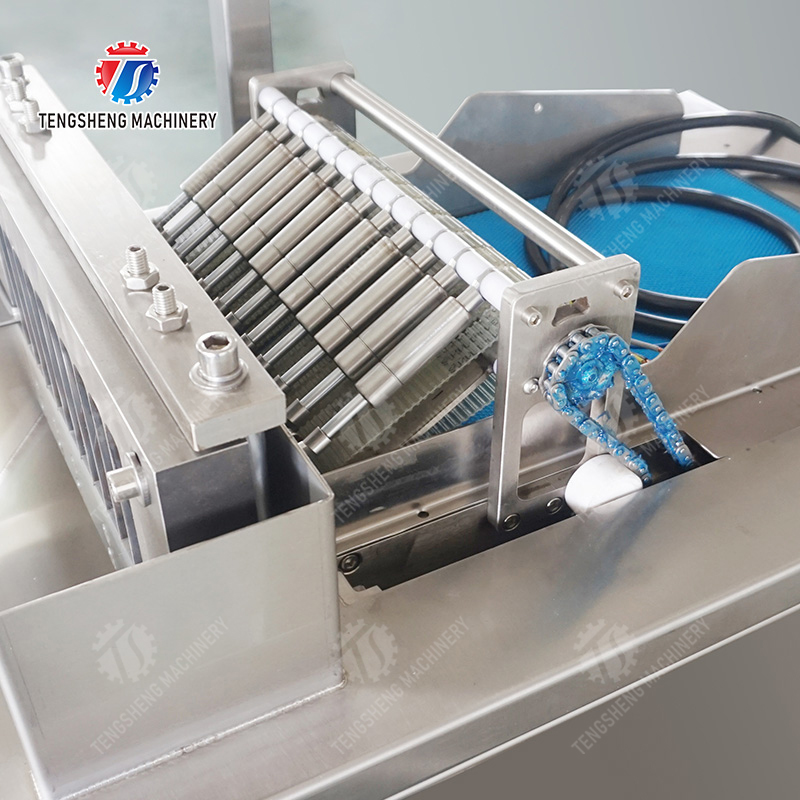
The ability of a chicken cutting machine to handle frozen meat correlates directly with blade material hardness and motor power rating. Blades made from high-carbon stainless steel with Rockwell hardness ratings of 56 to 58 HRC maintain edge retention longer when cutting frozen product compared to standard stainless blades. Motors rated at 1.5 kilowatts or higher provide the torque needed for continuous frozen cutting, whereas smaller fractional-horsepower motors may stall or overheat when asked to process dense frozen chicken blocks. Buyers should also consider whether the machine frame and transmission components are built to absorb the repeated impact forces that frozen cutting generates. Cast iron or heavy-gauge stainless steel frames with reinforced bearing housings indicate a machine engineered for demanding use. Some manufacturers, including Zhaoqing Tengsheng Machinery Co., Ltd., produce their cutting equipment using CNC-machined components and laser-cut structural parts, which contributes to tighter tolerances and more consistent blade alignment under load. These factors matter because even a slight blade misalignment when cutting frozen meat can cause binding, increased wear, and potential safety issues.
Cutting frozen chicken introduces food safety considerations that differ from processing fresh product. When a chicken cutting machine generates friction heat during frozen cutting, the outer layer of the meat can briefly enter the temperature danger zone between four degrees Celsius and sixty degrees Celsius, where bacterial growth accelerates. This risk is managed by keeping processing rooms cold, minimizing batch sizes exposed to ambient temperature, and cleaning blade surfaces frequently to prevent cross-contamination between batches. Machines with smooth, crevice-free stainless steel surfaces and tool-free blade removal, as found on some models such as the TS-36KS, make between-batch sanitation quicker and more thorough. Buyers whose operations require cutting frozen chicken should verify that equipment surfaces meet food contact material standards in their target markets, such as FDA 21 CFR in the United States or EU Regulation 1935/2004 in Europe. Additionally, selecting a chicken cutting machine with IP65 or higher-rated electrical enclosures prevents water ingress during washdown procedures, which is especially important when processing frozen product that requires more frequent cleaning cycles.
A mid-scale poultry processor handling approximately 1,500 kilograms of frozen chicken breast daily needed to portion blocks into uniform 150-gram cutlets. The initial approach of partially thawing blocks overnight, then cutting on a standard rotary slicer, created two problems: inconsistent portion weights due to variable thawing, and nearly two hours of daily blade cleaning because partially thawed meat residue adhered more aggressively to blade surfaces. After evaluating several options, the processor selected a guillotine-style chicken cutting machine with a 2.2-kilowatt motor, hardened stainless blade, and programmable portion thickness control. By cutting directly from frozen at minus 12 degrees Celsius, the operation eliminated the overnight thawing step, achieved portion weight consistency within plus or minus 3 grams, and reduced daily cleaning time by roughly 40 percent. The equipment investment was recovered through labor savings and reduced product giveaway within approximately fourteen months. This scenario highlights why matching machine specifications to the actual temperature state of the incoming raw material is a critical step in equipment selection that many buyers overlook.
Running a chicken cutting machine on frozen meat accelerates wear on several components beyond just the blade. Drive belts stretch faster under the higher torque loads, guide bushings experience more frequent impact stress, and blade sharpening intervals shorten significantly. A machine cutting fresh chicken might require blade sharpening every 40 to 60 operating hours, while the same machine processing frozen chicken may need sharpening every 15 to 25 hours. Buyers planning to cut frozen product should budget for a spare blade set at the time of equipment purchase, verify that replacement blades are available from the supplier with reasonable lead times, and establish a documented maintenance schedule that includes blade inspection after every shift. Machines with easily accessible blade assemblies significantly reduce the downtime associated with inspection and replacement. When contacting equipment suppliers, ask specifically about expected blade life when cutting frozen product at your target temperature range, not just general blade durability claims made for fresh product cutting.
Q: Can all chicken cutting machines cut frozen meat?
A: No. Band saw and guillotine-style chopping machines are generally capable of cutting frozen chicken, with saw-type machines handling fully frozen product at minus 18 degrees Celsius and guillotine machines typically effective down to approximately minus 10 degrees Celsius. Rotary blade slicers and disc cutters are designed primarily for fresh or chilled chicken and should not be used on fully frozen product without manufacturer confirmation.
Q: What happens if I use a standard fresh-meat cutter on frozen chicken?
A: The most likely outcomes are uneven or incomplete cuts, accelerated blade dulling, motor overheating or stalling, and potential damage to drive components. Over time, the repeated stress can cause permanent misalignment of cutting assemblies and premature bearing failure.
Q: Do I need special blades for frozen chicken cutting?
A: Machines used for frozen cutting benefit from blades with higher Rockwell hardness ratings, typically 56 to 58 HRC. Some applications use serrated or scalloped blade edges that grip frozen surfaces better during the initial cut. Always confirm with the equipment manufacturer that the supplied blade set is rated for the specific temperature range you intend to process.

Copyright © 2024 Zhaoqing Tengsheng Machinery Co., Ltd all rights reserved - Privacy policy