Restaurant kitchens handle vegetables differently than industrial food factories. A central processing plant may run a single vegetable type for eight hours straight, but a restaurant kitchen might process lettuce, carrots, onions, potatoes, and bell peppers all within a thirty-minute prep window. This fundamental difference means that choosing a vegetable processing machine for a restaurant requires evaluating factors that factory buyers rarely consider: size versatility, quick changeover, countertop footprint, noise level during service hours, and the ability to produce multiple cut styles without swapping heavy attachments. Getting the selection right can reduce prep labor by 40 to 60 percent and improve plate consistency, while getting it wrong means an expensive machine collecting dust in the corner.
The first step in choosing a vegetable processing machine is mapping out exactly what vegetables your kitchen processes, in what volumes, and at what frequency. A salad-focused restaurant processing 30 kilograms of mixed greens, cucumbers, and tomatoes daily has very different needs from a ramen shop slicing 5 kilograms of green onions and 10 kilograms of cabbage per day. Document the vegetables by category: leafy greens requiring gentle handling, firm root vegetables needing powerful cutting, and soft produce like tomatoes that demand sharp blades and minimal compression. For each category, note the target cut specification: shred width, slice thickness, dice cube size, or julienne dimensions. This exercise often reveals that a restaurant needs two different machine types rather than one multi-purpose unit, or alternatively that a single well-chosen multi-functional vegetable cutting machine can handle the entire menu if changeover speed meets kitchen workflow demands.
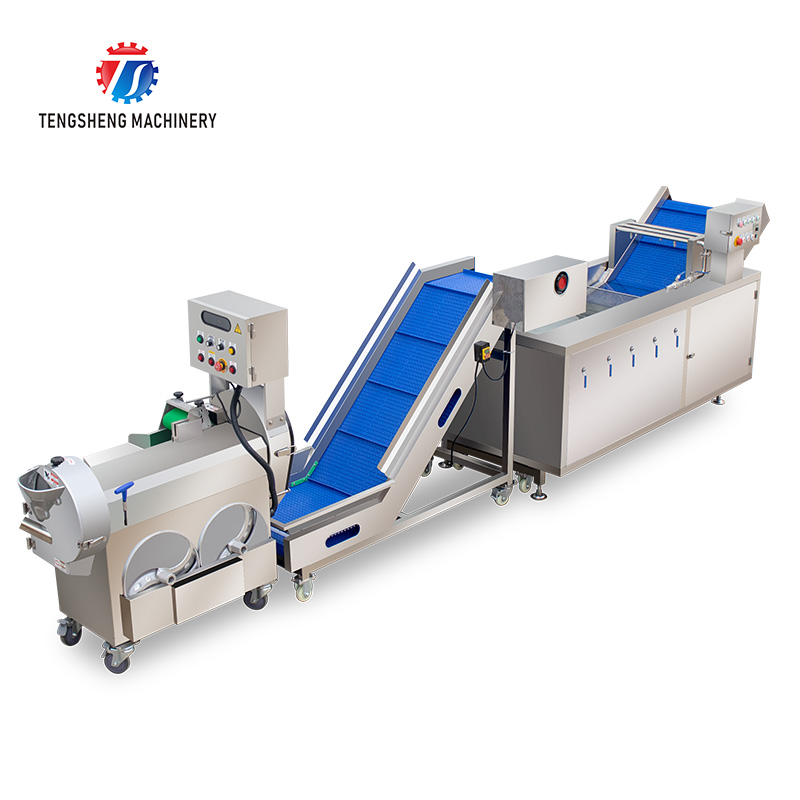
Restaurant buyers typically encounter four categories of vegetable processing machines. Vegetable washers and dryers handle the cleaning and spin-drying step; machines like the TS-AZ single-tank vegetable washer combine washing with optional blanching capability and suit medium-volume kitchens. Peelers range from abrasive drum units for potatoes and carrots to specialized machines for garlic and onions. Cutting machines constitute the largest category, encompassing slicers, shredders, dicers, and multi-functional units such as the TS-Q103 bamboo shoot slicer, TS-Q200 vegetable dicer, and the TS-Q118B dual-head vegetable cutter that can run two different cutting operations simultaneously. Auxiliary equipment like conveyor systems and packaging machines typically only become relevant for restaurants running central kitchen operations that supply multiple locations. For a single-location restaurant, a washing unit paired with one high-quality multi-functional vegetable processing machine usually covers 80 to 90 percent of prep needs. Adding a dedicated peeler makes sense when processing more than 20 kilograms of root vegetables daily.
Inconsistent vegetable cuts affect more than plate appearance: they drive up food cost through uneven cooking and portion variance. When carrot slices vary between 2 millimeters and 5 millimeters thick in the same batch, the thinner pieces overcook while the thicker ones remain undercooked, leading to plate waste and customer dissatisfaction. A precision vegetable processing machine with hardened stainless steel cutting discs consistently produces slices within a tolerance of approximately plus or minus 0.5 millimeters. This consistency also enables accurate recipe costing because each portion uses a predictable number of pieces. For restaurants, the financial case for a dedicated vegetable processing machine often rests more on portion consistency and waste reduction than on raw labor savings alone. Buyers should request cut sample demonstrations using their actual produce varieties before committing to a purchase because different vegetable moisture content and fiber structure affect how cleanly a given blade set cuts.
Restaurant kitchens rarely have the open floor space of a factory. A vegetable processing machine that dominates a prep table or requires permanent floor mounting may be impractical regardless of its technical capability. Compact countertop models in the TS-Q series, with footprints measuring roughly 500 to 700 millimeters in width, fit standard stainless steel prep tables and can be moved into storage during service hours if space is tight. Noise level during operation is another restaurant-specific consideration. While a factory environment tolerates 85-decibel equipment running continuously, a restaurant kitchen during prep hours typically benefits from machines operating at 70 decibels or below so that kitchen communication is not disrupted. Machines with belt-driven transmissions tend to run quieter than direct-gear-drive units, although gear drives offer higher torque for dense vegetables. For restaurants that prep during service hours, prioritizing a quieter belt-drive vegetable processing machine may be the better operational choice even if it means slightly slower throughput for tough produce.
Restaurant health inspections scrutinize food contact surfaces, and a vegetable processing machine with hidden crevices, difficult-to-remove blade assemblies, or non-food-grade materials invites inspection violations. Machines constructed with 304-grade stainless steel for all food contact surfaces and featuring tool-free blade removal for daily cleaning significantly reduce sanitation labor and compliance risk. Sealed bearings that prevent food particle ingress and smooth, polished surface finishes that resist bacterial biofilm formation are features worth paying extra for in a restaurant context. The TS-AZ washer series, for example, incorporates accessible drain ports and smooth tank interiors that simplify end-of-shift cleaning. When evaluating any vegetable processing machine, physically check whether all blade assemblies can be removed and reassembled in under two minutes by a single person, because cleaning procedures that take too long tend to be skipped during busy shifts.
A mid-scale restaurant serving approximately 200 covers daily across lunch and dinner services previously employed three full-time prep cooks whose primary task was manual vegetable cutting. The menu included stir-fried dishes requiring julienned carrots and peppers, salads with shredded cabbage and sliced cucumbers, and soups with diced potatoes and onions. After mapping cutting specifications by vegetable type and daily volume, the restaurant invested in one dual-head vegetable processing machine capable of simultaneous slicing and shredding operations, plus a compact abrasive peeler for root vegetables. The prep team was reduced from three cooks to one, with that one person completing the same prep volume in roughly three hours compared to the previous nine labor-hours. More importantly, cut consistency improved to the point where stir-fry cook times became predictable, reducing plate return rates related to undercooked vegetables by approximately 70 percent. The equipment cost was recovered within seven months through labor savings alone, not counting the food cost improvement from reduced waste.
A restaurant that starts with a single vegetable processing machine may eventually outgrow it as menu complexity increases or as the operation expands to catering or multi-location production. Planning for this scenario during the initial purchase means choosing equipment from a manufacturer with a broad product range so that additional machines can integrate into the existing workflow without compatibility issues. A supplier offering everything from single-tank washers to full production lines, such as complete fruit and vegetable sorting, washing, air-drying, and transfer systems, provides a growth path that a niche supplier may not. The initial vegetable processing machine purchase should also account for electrical requirements: a three-phase power machine may offer better long-term value but requires confirming that the restaurant's electrical panel supports it before ordering.
Q: Should a restaurant buy separate machines for washing and cutting, or a combined unit?
A: Separate machines are generally recommended for restaurants. A combined washing and cutting unit that fails puts your entire prep operation on hold, whereas separate units allow you to continue partial operations during repairs. Separate units also offer more flexibility as your menu changes over time. The exception is very small kitchens where counter space simply cannot accommodate two separate machines.
Q: What cutting specifications should I prioritize when comparing machines?
A: Focus on the three cuts your kitchen uses most frequently, not the machine's total number of possible cut styles. A machine offering twelve cut configurations where eight are irrelevant to your menu provides no practical advantage. Request cut samples using your actual vegetables at your target specifications before purchasing.
Q: How much daily cleaning time should I budget for a restaurant vegetable processing machine?
A: With a well-designed machine featuring tool-free blade removal, a single person should be able to disassemble, clean, sanitize, and reassemble all food contact parts in 10 to 15 minutes. Machines requiring tools for blade removal may take 25 to 40 minutes, which adds up to significant labor over a year of daily cleaning.

Copyright © 2024 Zhaoqing Tengsheng Machinery Co., Ltd all rights reserved - Privacy policy