

Choosing a vegetable slicing machine for high-volume kitchens
Choosing a vegetable slicing machine for a central kitchen is less about finding the longest feature list and more about protecting the prep schedule. When hundreds of portions move through a kitchen each day, a slicer has to fit the vegetables, the target cut, the cleaning routine, and the next operation—not merely look fast on a product sheet.
From a central-kitchen buyer’s perspective, cut consistency, changeover speed, and daily maintenance belong in the same comparison. The right choice is the one that can be verified against your own ingredients and workflow. If raw-material condition is stable, the framework below is a useful starting point; the final configuration should still be confirmed against the process.
Start with the job, not the machine category
Search results for a vegetable slicing machine often mix household choppers, portable multi-function tools, and commercial equipment. That makes a simple “one-size-fits-all machine” answer unreliable for a high-volume operation. Begin by writing a short production brief before comparing equipment.
- Vegetables: List the main products, their firmness, diameter range, moisture level, and whether they arrive washed or require pre-processing.
- Finished cut: Define slice thickness, shape, tolerance, and whether a single cut or several formats are required during one shift.
- Demand pattern: Record peak-hour demand, batch size, shifts, and the time available for changeovers and cleaning.
- Process position: Identify what comes before slicing and what receives the product afterward, such as washing, weighing, packing, cooking, or chilled holding.
- People and space: Note feeding method, operator access, drainage, power availability, and cleaning access around the unit.
That short brief changes an online search into an operational comparison. Instead of asking whether a machine can slice vegetables, ask whether it can make the required cut continuously at your busiest point without creating a queue upstream or downstream.
Match vegetable slicing machine throughput to the whole prep line
For high-volume kitchens, stated capacity is only a starting signal. Actual output depends on how evenly staff can feed prepared vegetables, how often the cut changes, and how reliably the sliced product leaves the cutting area. A vegetable slicing machine that runs quickly in isolation can still slow a line if operators must pause to sort produce, clear discharge buildup, or wait for the next process.
A practical review starts with the rhythm of a typical shift. Observe whether washing and inspection can supply the slicer continuously, whether the receiving bins or conveyor can accept the output, and whether packing or cooking can keep pace. Before discussing a vegetable slicing machine, check whether it can connect to the rhythm of upstream washing and downstream packing. This line-level view is especially useful for food processors, chains, school or factory kitchens, and prepared-food facilities where several items compete for the same prep window.
Ask a supplier to explain the conditions behind any capacity figure: vegetable type, cut style, preparation condition, feeding method, and test duration. A capacity number without those conditions is difficult to compare fairly.
Test vegetable slicing machine cut quality before “multi-function” claims
Cut requirements are product requirements. A vegetable slicing machine should be assessed against the slice thickness and visual consistency your recipe, packing format, or later cooking step needs. The key question is not simply how many cutting options are available, but whether the relevant option produces an acceptable result across the normal variation in your vegetables.
Request a demonstration using representative ingredients whenever possible. Include firm and softer items if both are part of the menu, and inspect the result after the machine has been running long enough to show real operating behavior. Look for repeatable thickness, manageable breakage, clean separation, and a discharge pattern that does not crush or scatter the product.
During evaluation, it is often better to observe continuous feeding first and debate a headline capacity second. Do not treat a sample cut as proof of suitability until the intended production conditions are clear.
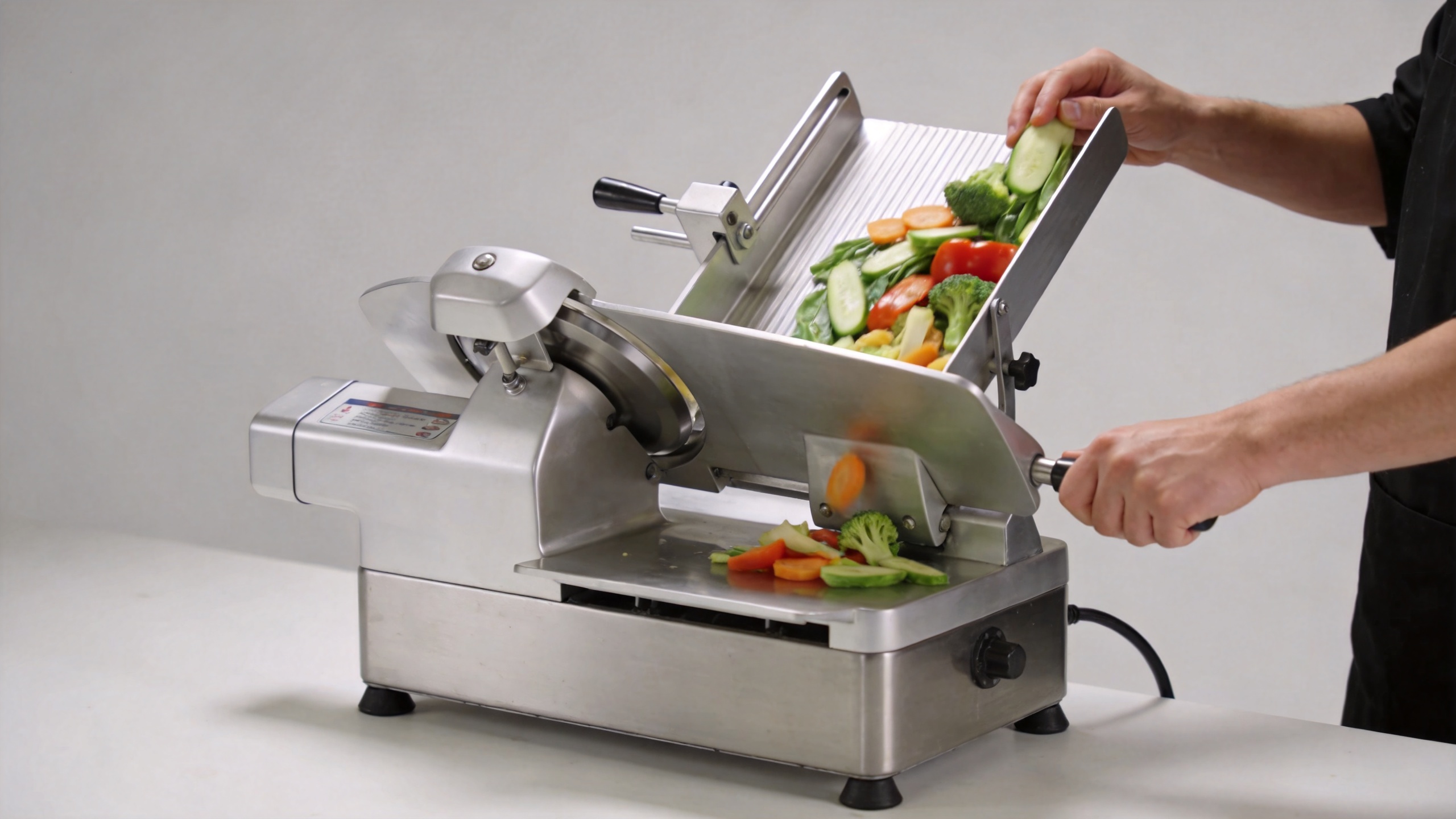
Evaluate vegetable slicing machine feeding, discharge, and operator actions
Function lists rarely show the small movements that shape a shift. Watch how an operator loads ingredients, positions the pusher or feed arrangement, removes product, changes cutting components, and completes the cleaning routine. These movements determine whether the equipment is practical for the people who will use it repeatedly.
- Can the feeding arrangement accommodate your usual vegetable sizes without excessive trimming?
- Does the operator have a clear, safe position for loading and unloading?
- Is the discharge route compatible with your container, conveyor, or next station?
- How are cutting parts handled during a format change, and what checks are required before restart?
- Can the team reach all food-contact areas without unsafe stretching or awkward lifting?
For a production team, these are not minor details. In a high-volume kitchen, a few extra handling steps repeated throughout the day can affect labor coordination, sanitation timing, and the likelihood of rushed work.
Make vegetable slicing machine cleanability a selection criterion
Food-contact equipment must be suitable for cleaning and sanitizing under the procedures that apply to the facility. The FDA Food Code 2022, for example, describes food-contact surfaces as needing to avoid conditions such as cracks, open seams, and difficult crevices, and requires food-contact surfaces and utensils to be sanitized. That is a useful purchasing lens rather than a claim that any particular vegetable slicing machine meets a specific standard.
Ask for the cleaning sequence in practical terms: which guards, cutting parts, and covers are removed; what tools are required; how the parts are identified after cleaning; and how the machine is inspected before return to service. Removable parts can be useful only when the team can remove, clean, sanitize, dry, and reinstall them consistently.
Build cleaning time into the throughput discussion. A machine that seems productive but requires difficult access between batches may not fit an operation with frequent product changes or strict sanitation windows.
Check vegetable slicing machine safety and maintenance before approval
High-volume preparation rewards predictable routines. Ask how guards, covers, start controls, and emergency-stop arrangements work during ordinary use and during cleaning. The site’s own safety procedures and local requirements should govern the final assessment. A demonstration should include normal operation, controlled stop, component change, and restart checks—not only cutting footage.
Maintenance needs the same attention. Clarify the inspection schedule, cutting-component replacement process, expected spare-part planning, service access, and the information the operator should record when cut quality changes. Initial price is only one part of the decision; cleaning, maintenance, labor coordination, and downtime exposure should also be evaluated using real shift data.
A practical comparison table for a vegetable slicing machine
| Evaluation area | What to verify | Why it matters |
|---|---|---|
| Ingredients | Normal vegetable types, size range, condition, and preparation state | Determines whether the feeding and cutting arrangement fit the real product. |
| Finished cut | Thickness, shape, consistency, breakage, and changeover needs | Keeps the selection tied to recipe and packaging requirements. |
| Line flow | Upstream supply, discharge handling, and downstream capacity | Prevents a fast standalone unit from becoming a process bottleneck. |
| Cleaning | Access to food-contact areas, removable parts, inspection, and sanitation routine | Supports repeatable hygiene practice and realistic labor planning. |
| Safety and support | Operating safeguards, training, service access, and replacement planning | Helps the kitchen sustain dependable operation after commissioning. |
Questions to send before requesting a vegetable slicing machine quotation
- Which vegetables and target slice formats will be processed most often?
- What is the required output during the busiest production window?
- Are ingredients washed before slicing, and how will they be fed to the machine?
- What equipment handles the product immediately after slicing?
- How much time is available for changeover and sanitation between products?
- What site conditions affect installation, cleaning, drainage, power, or operator access?
For a kitchen that supports several menus or facilities, include the future mix as well as today’s most common recipe. The right vegetable slicing machine is not necessarily the one with the broadest list of possible cuts; it is the one whose verified operating range matches the cuts, volumes, staffing, and cleaning discipline you can sustain.
Conclusion
Choose a vegetable slicing machine by validating the flow around it: ingredient preparation, target cut, continuous feeding, discharge, cleaning, safety, and maintenance. Zhaoqing Tengsheng Machinery Co., Ltd serves food processing, food chains, central kitchens, school and factory canteens, and prepared-food factories. Share your vegetable list, desired cut, production window, and line layout to start a configuration discussion based on your actual process rather than a generic capacity claim.