Hard root vegetables such as carrots, potatoes, sweet potatoes, taro, and beets present a unique challenge for cutting equipment. Their dense, fibrous structure requires significant cutting force, and the irregular shapes of many root varieties make consistent feed alignment difficult. A common question from food processing facility managers is whether a vegetable julienne machine designed for softer produce can effectively handle these demanding materials without compromising cut quality or equipment longevity. The short answer is yes, but only if the machine is specifically engineered for root vegetable processing with appropriate blade geometry, motor power, and feed mechanism design.
Root vegetables have several characteristics that make julienne cutting particularly challenging. First, their high density requires the blade to apply significantly more force per cut than when processing leafy greens or soft fruits. A carrot, for example, has a density of approximately 0.94 grams per cubic centimeter, compared to 0.46 for iceberg lettuce. Second, many root vegetables have irregular, non-uniform shapes with tapered ends, bends, or surface irregularities that cause the produce to shift during cutting, resulting in uneven julienne strips. Third, the fibrous interior structure of some root vegetables, particularly older carrots and celery root, can cause blades to catch and tear rather than make clean cuts if the blade edge is not sharp enough or the cutting speed is too low. Fourth, root vegetables often carry adhered soil that, if not adequately removed before cutting, acts as an abrasive that accelerates blade wear. For these reasons, a vegetable julienne machine intended for root vegetable processing must be designed with these material properties in mind.
The cutting mechanism is the most critical factor determining whether a vegetable julienne machine can handle hard root vegetables. Two cutting mechanisms are commonly used. The first is centrifugal cutting, where produce is held against the inner wall of a rotating drum by centrifugal force, and stationary blades mounted in the drum wall slice the produce as it rotates. This mechanism, used in the TS-Q1500A high-speed julienne machine, provides high cutting speed and consistent strip dimensions because the centrifugal force maintains positive contact between the produce and the blade throughout the cut. The TS-Q1500A uses 304 stainless steel construction with a sandblasted finish and one-piece cutting tools that are sharp out of the box and require no sharpening, only replacement. The second mechanism is the rotating disk with mounted blades, where produce is fed through a hopper onto a spinning disk equipped with julienne blades. This design is common in smaller machines but may struggle with the hardest root vegetables because the disk speed and blade angle may not generate sufficient cutting force for dense materials. For buyers processing primarily hard root vegetables, centrifugal cutting machines are generally the better choice.
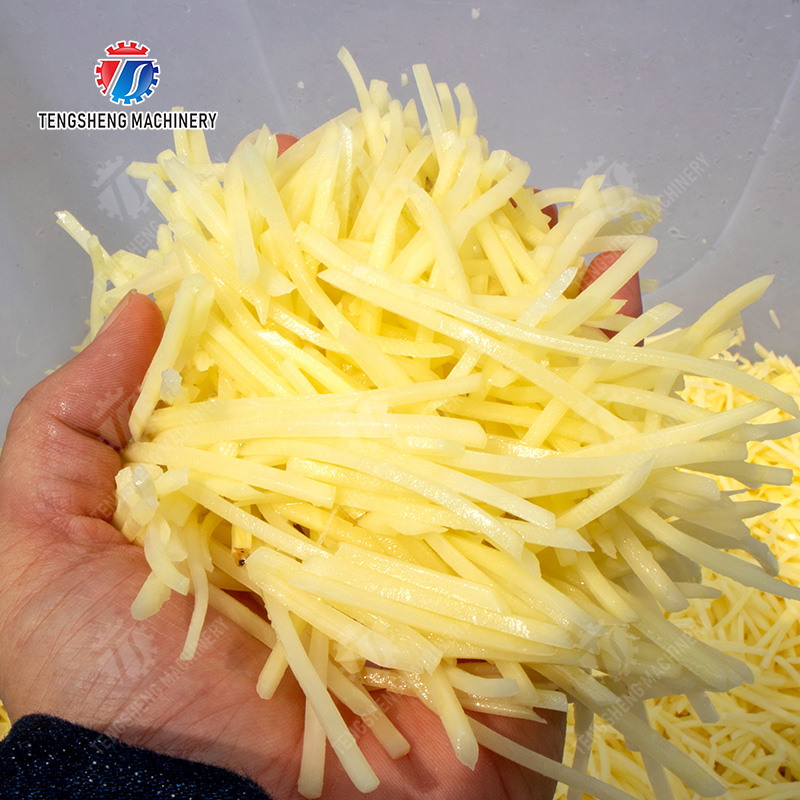
A vegetable julienne machine processing hard root vegetables requires sufficient motor power to maintain consistent blade speed under load. When the blade encounters a dense carrot or sweet potato, the motor must deliver enough torque to push through the resistance without stalling or slowing down. A motor that slows under load produces uneven julienne strips with torn edges, which affects product appearance and shelf life. Frequency-controlled motors, such as those available as an option on the TS-Q1500A, allow operators to adjust cutting speed to match the hardness of the produce being processed, providing flexibility when switching between soft and hard materials. The feed mechanism also plays a role. Machines with a gravity-fed hopper allow the weight of the produce to assist in maintaining contact with the cutting surface, which is beneficial for irregularly shaped root vegetables. Machines with forced feed mechanisms, such as auger or piston feed, provide more positive control over produce positioning but may require pre-sizing of large root vegetables to fit the feed opening. When evaluating throughput, be aware that processing hard root vegetables typically yields 15 to 25 percent lower actual throughput than the machine's rated capacity for soft produce, because the cutting speed must be reduced to maintain cut quality.
Processing hard root vegetables accelerates wear on all components of a vegetable julienne machine, making material quality and maintainability critical selection criteria. The machine frame and cutting chamber should be constructed from SUS304 or 304 stainless steel to resist corrosion from root vegetable starches and soil residues. The TS-Q1500A's 304 stainless steel construction with sandblasted finish provides both corrosion resistance and a surface that is easy to clean and does not harbor bacteria. Blade life is significantly shorter when processing hard root vegetables compared to soft produce. Buyers should expect blade replacement every 40 to 60 operating hours when primarily processing carrots, potatoes, and similar dense materials, compared to 80 to 100 hours for soft produce. The one-piece replacement blade design of the TS-Q1500A allows operators to change blades quickly without specialized tools, minimizing downtime. When evaluating suppliers, ask about blade cost per set, expected blade life for your specific product mix, and whether replacement blades are stocked locally or require import lead times. Also confirm that the machine has accessible cleaning ports and removable guards that allow thorough cleaning of the cutting chamber, as root vegetable starch residue can harden and create sanitation issues if not removed promptly after each use.
A fresh-cut salad processing facility producing pre-packaged julienne carrot sticks for retail needed to evaluate whether a centrifugal vegetable julienne machine could replace their existing manual cutting process. The facility processed approximately 300 kg of carrots per day, requiring julienne strips of 3 mm by 3 mm cross-section. Carrots were pre-washed and sized to 100 to 150 mm lengths before cutting. The facility selected a TS-Q1500A centrifugal julienne machine with 304 stainless steel construction and frequency-controlled motor speed. During testing, the machine was operated at 70 percent of maximum speed to maintain clean cut edges on the carrot fibers. Actual throughput was measured at 220 kg per hour, compared to the machine's rated capacity of approximately 300 kg per hour for soft produce, confirming the 25 percent throughput reduction expected for hard root vegetables. Julienne strip dimensions were consistent at 3.0 to 3.2 mm, with less than 2 percent irregularity rate. Blade replacement was required every 55 operating hours on average. The facility estimated annual labor savings of approximately 65 percent compared to the previous manual process, with payback on the equipment investment in approximately 10 months.
What types of root vegetables can a julienne machine process?
Most commercial vegetable julienne machines designed for root vegetable processing can handle carrots, potatoes, sweet potatoes, taro, beets, radishes, turnips, and parsnips. The key requirements are that the produce is pre-washed to remove abrasive soil, pre-sized to fit the machine feed opening, and that the machine has sufficient motor power and appropriate blade geometry for dense materials. Very hard or woody roots such as mature ginger or cassava may require specialized equipment.
Why is my julienne machine producing uneven strips from root vegetables?
Uneven julienne strips typically result from one of four causes: dull blades that tear rather than cut cleanly, insufficient motor speed for the density of the produce, irregular produce shapes that shift during cutting, or overloading the feed hopper beyond the machine's capacity. Start by replacing the blade set if it has been in use for more than 50 hours with root vegetables. Then reduce the feed rate and ensure produce is pre-sized to uniform dimensions before cutting.
How does centrifugal cutting compare to disk cutting for root vegetables?
Centrifugal cutting machines, such as the TS-Q1500A, use centrifugal force to maintain contact between the produce and the blade, which provides more consistent cutting pressure on dense root vegetables. Disk cutting machines rely on gravity and feed mechanism pressure, which can be less consistent with irregularly shaped roots. For facilities primarily processing hard root vegetables, centrifugal cutting generally produces more uniform julienne strips with fewer rejects.

Copyright © 2024 Zhaoqing Tengsheng Machinery Co., Ltd all rights reserved - Privacy policy