A vegetable chopper machine is one of the most frequently purchased pieces of equipment for commercial kitchens, food processing facilities, and institutional cafeterias. Choosing the right one requires looking beyond the purchase price and evaluating factors such as cut type versatility, throughput capacity, material quality, blade replacement cost, and safety features. The wrong choice can lead to inconsistent cut quality, excessive maintenance downtime, or equipment that cannot keep up with peak production demand. This guide walks through the key criteria that procurement managers and facility operators should evaluate when comparing vegetable chopper machines for commercial use.
The first criterion in selecting a vegetable chopper machine is the range of cut types it can produce. Commercial operations typically need at least three cuts: slicing, dicing, and shredding or julienne. Some operations also require specialty cuts such as oblique slices for presentation or chunk cuts for stews. Machines that offer interchangeable blade sets or multi-function cutting heads provide greater versatility without requiring multiple machines. The TS-Q118B dual-head vegetable cutting machine, for example, uses two independent cutting heads that can operate simultaneously, one configured for leafy vegetables and the other for root vegetables. This design allows a single machine to handle a broader product range than a single-head cutter. The TS-Q180D large dicing machine uses a composite blade system that produces dice, strips, and slices in a single pass, eliminating the need to reprocess product through a second machine. When evaluating versatility, also consider how quickly the machine can switch between cut types. Machines with tool-less blade change systems reduce downtime between product changeovers, which is particularly important for facilities processing multiple products per shift.
Vegetable chopper machines vary significantly in throughput capacity, from small-scale units processing 100 kg per hour to industrial machines handling several hundred kilograms per hour. To select the right capacity, first calculate your peak hour demand, which is the maximum volume of cut product you need to produce during your busiest operating hour. Add a 20 percent buffer to account for feed irregularities, produce shape variations, and cleaning breaks. The result is your minimum required machine capacity. For example, a central kitchen supplying 500 kg of cut vegetables per day across an 8-hour shift has an average demand of 62.5 kg per hour, but if 40 percent of daily volume is needed during the 2-hour lunch prep window, peak demand rises to 100 kg per hour, requiring a machine rated for at least 120 kg per hour. The TS-Q180 high-speed dicing and slicing machine is rated to replace the output of approximately 25 manual workers, making it suitable for operations where high throughput during peak periods is critical. Its SUS304 stainless steel frame ensures durability under continuous commercial use.
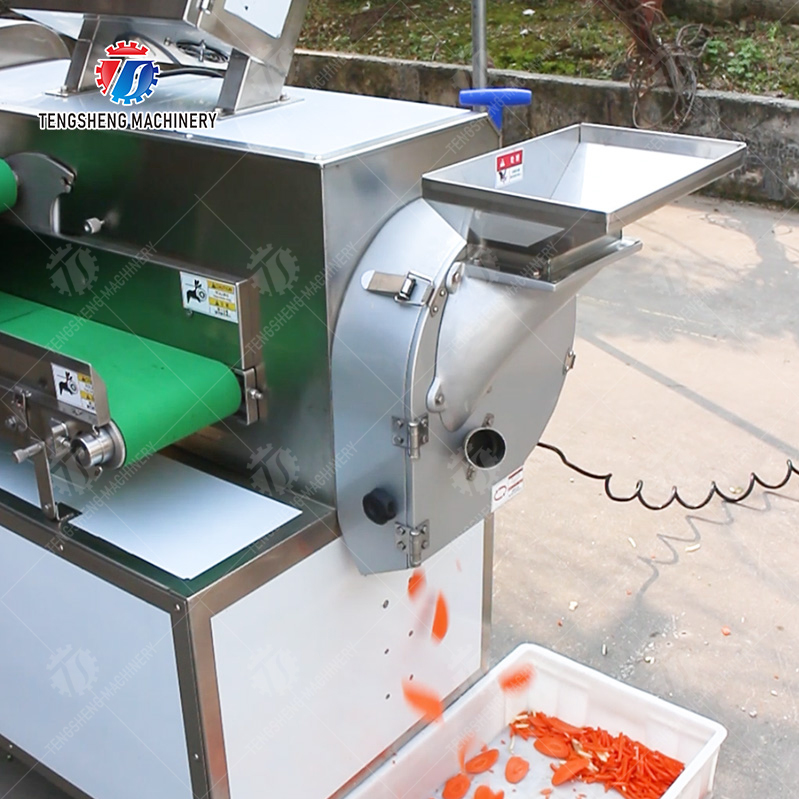
The construction material of a vegetable chopper machine directly affects food safety, equipment longevity, and maintenance requirements. SUS304 stainless steel is the industry standard for food contact surfaces because it resists corrosion from acidic vegetable juices, withstands repeated washdown with cleaning chemicals, and does not transfer odors or flavors between products. Machines built with SUS304 frames, such as the TS-Q180 and TS-Q180D, provide long-term durability in high-moisture environments. When evaluating material quality, check not only the frame but also the blade material, feed chute lining, and discharge chute surfaces. Blades should be made from food-grade stainless steel with a hardness rating sufficient to maintain edge sharpness over extended use. Avoid machines with painted or coated surfaces in product contact zones, as coatings can chip and contaminate product. Look for machines with smooth, weld-free surfaces in product contact areas, rounded internal corners that prevent product accumulation, and drainage ports that allow effective cleaning after use.
The blade system is the most critical wear component of a vegetable chopper machine, and its design affects both cut quality and long-term operating cost. Three blade system types are common. First, fixed blade sets are permanently mounted and must be sharpened in place or replaced as a complete unit, which is simpler but may require sending the machine to the manufacturer for sharpening. Second, replaceable cartridge blades, such as the one-piece cutting tools used in the TS-Q1500A high-speed julienne machine, can be swapped by the operator in minutes, minimizing downtime and eliminating the need for in-house sharpening equipment. Third, composite blade systems, like those in the TS-Q180D, combine multiple cutting actions in a single blade assembly, reducing the number of parts to maintain but potentially costing more per replacement. When comparing machines, ask the supplier for the expected blade life in operating hours, the cost of replacement blade sets, and the typical delivery lead time for spares. A machine with inexpensive, readily available blades may have a lower total cost of ownership than a cheaper machine with expensive, hard-to-source blades.
Commercial vegetable chopper machines operate with high-speed blades that pose significant injury risk if safety features are inadequate. Key safety features to evaluate include microswitch interlocks on feed covers that prevent machine operation when the cover is open, emergency stop buttons positioned within easy reach of the operator, and feed chutes designed long enough that the operator's hand cannot reach the blade area during loading. The TS-Q180 incorporates a microswitch safety device at the feed inlet that immediately stops blade rotation when the feed cover is opened. For machines used in environments with multiple operators or shift changes, consider additional safety measures such as keyed start switches that prevent unauthorized operation and blade guards that remain in place during use. Compliance with electrical safety standards and proper grounding are also essential, particularly in wet processing environments where the risk of electrical shock is elevated.
A catering company producing 800 meals per day needed to replace a worn-out vegetable chopper machine. The company processed a mix of leafy greens, root vegetables, and specialty items such as bamboo shoots and mushrooms across two daily prep sessions. Peak demand during the morning session required approximately 150 kg of cut vegetables per hour. After evaluating several options, the company selected a TS-Q118B dual-head cutting machine, which allowed simultaneous processing of leafy and root vegetables without changeover. The machine was specified with SUS304 stainless steel construction and a set of interchangeable blade cartridges for julienne, slice, and dice cuts. During the first three months of operation, the company reported a 30 percent reduction in prep time compared to the previous single-head machine, primarily due to the dual-head design eliminating the need to flush and reconfigure between leafy and root vegetable batches. Replacement blade cartridges were stocked based on a 50-hour replacement interval, ensuring minimal downtime.
What is the difference between a single-head and dual-head vegetable chopper machine?
A single-head machine has one cutting station that processes one type of produce at a time, requiring changeover when switching between leafy and root vegetables. A dual-head machine, such as the TS-Q118B, has two independent cutting heads that can operate simultaneously, allowing one head to process leafy vegetables while the other handles root vegetables, which significantly reduces changeover time and increases throughput for mixed-product operations.
How often do blades need to be replaced on a commercial vegetable chopper?
Blade replacement frequency depends on the volume and type of produce processed, the blade material, and whether the machine includes water spray lubrication during cutting. As a general guideline, expect to replace blades every 50 to 80 operating hours for machines processing abrasive root vegetables such as carrots and potatoes. Machines processing softer produce such as tomatoes and leafy greens may extend blade life to 100 hours or more. Always maintain spare blade sets in inventory to minimize downtime.
Is SUS304 stainless steel necessary for a vegetable chopper machine?
SUS304 stainless steel is strongly recommended for commercial vegetable chopper machines because it resists corrosion from acidic vegetable juices, withstands repeated washdown with sanitizing chemicals, and does not transfer flavors or odors between products. Machines with carbon steel or painted surfaces in product contact zones will corrode over time, potentially contaminating product and requiring more frequent replacement. The higher initial cost of SUS304 construction is offset by longer equipment life and lower maintenance costs.

Copyright © 2024 Zhaoqing Tengsheng Machinery Co., Ltd all rights reserved - Privacy policy