

Improving food prep speed with a vegetable chopper machine
When prep falls behind, the visible problem is often a cutting station. The less visible problem is the gap between washing, loading, cutting, collection, and cleaning. A vegetable chopper machine can support a faster routine, but only when it fits the ingredients and the work around it. For central kitchens, prepared-food facilities, school or factory canteens, and food-service operations, the useful question is not simply “How fast does it cut?” It is “Where does time disappear during a normal prep shift?”
From a vegetable-preparation workflow perspective, speed should be treated as a sequence of repeatable actions. The right vegetable chopper machine may reduce hand-cutting time, yet queues can remain if vegetables arrive inconsistently, operators pause to change cuts, or trays fill faster than they can be removed. Looking at the whole sequence gives a more reliable starting point for a food-processing equipment discussion.
Why food-prep speed is more than a cutting-rate question
A busy prep room has several clocks running at once: ingredient delivery, washing, sorting, cutting, transfer, and sanitation. If one station waits, the people before and after it wait too. This is why a vegetable chopper machine should be evaluated as part of a flow rather than as an isolated appliance. A nominal capacity figure may be useful for comparison, but it does not show whether the operator can keep the feed steady or whether the next station can accept the prepared vegetables.
For example, leafy vegetables, root vegetables, onions, and mixed produce can arrive with different sizes, moisture levels, and trimming needs. Those conditions influence preparation before material reaches a vegetable chopper machine. In practical planning, teams often first observe whether loading is continuous and only then discuss stated capacity. That small change in sequence helps expose delays that a brochure comparison can miss.
Map the current prep route before selecting equipment
Start by following one batch from receiving to the next process. Record where a person touches the product, where containers are changed, and where the batch stops. This does not require a complex study. A simple shift observation can show whether the bottleneck is manual knife work, uneven feeding, collection, cleaning, or the handoff to packaging or cooking.
- Define the raw material. Note vegetable type, typical size range, condition after washing, and whether trimming is required.
- Define the finished cut. Identify the intended slice, shred, dice, or other format and whether one line handles multiple cuts in a shift.
- Follow the handoffs. Check how product reaches the vegetable chopper machine, where it lands afterward, and who clears containers.
- Include sanitation time. Record access, disassembly steps, rinsing, inspection, and reassembly under the site’s own hygiene procedure.
This map makes the decision more specific. A vegetable chopper machine may be appropriate when cutting is truly the limiting task; a different layout or upstream preparation change may be more useful when the limiting task is elsewhere.
Match the machine to ingredients and target cuts
It is tempting to begin with a feature list. A more useful order is to begin with ingredients and finished-product requirements. Before comparing a vegetable chopper machine, clarify whether the operation handles firm roots, softer produce, leafy items, or a variable mix. Then clarify the required cut appearance, portion of the batch that needs each cut, and the tolerance for changeover between menu items.
The same label can cover equipment intended for very different conditions. A vegetable chopper machine that fits a steady stream of prepared vegetables may not suit a process that requires extensive manual trimming or frequent switching between highly different ingredients. Instead of assuming one format will serve every task, ask suppliers to confirm the raw-material conditions and cut requirements against the proposed configuration.
Do not focus only on blade count or a single throughput claim. The cutting system, feed opening, operator access, collection arrangement, and cleaning approach all influence usable prep speed. If a demonstration is available, use representative ingredients and the intended finished cut. Observe the complete working cycle, including loading and clearing, rather than timing only the moment when the vegetable chopper machine is cutting.
Protect flow at the loading and discharge points
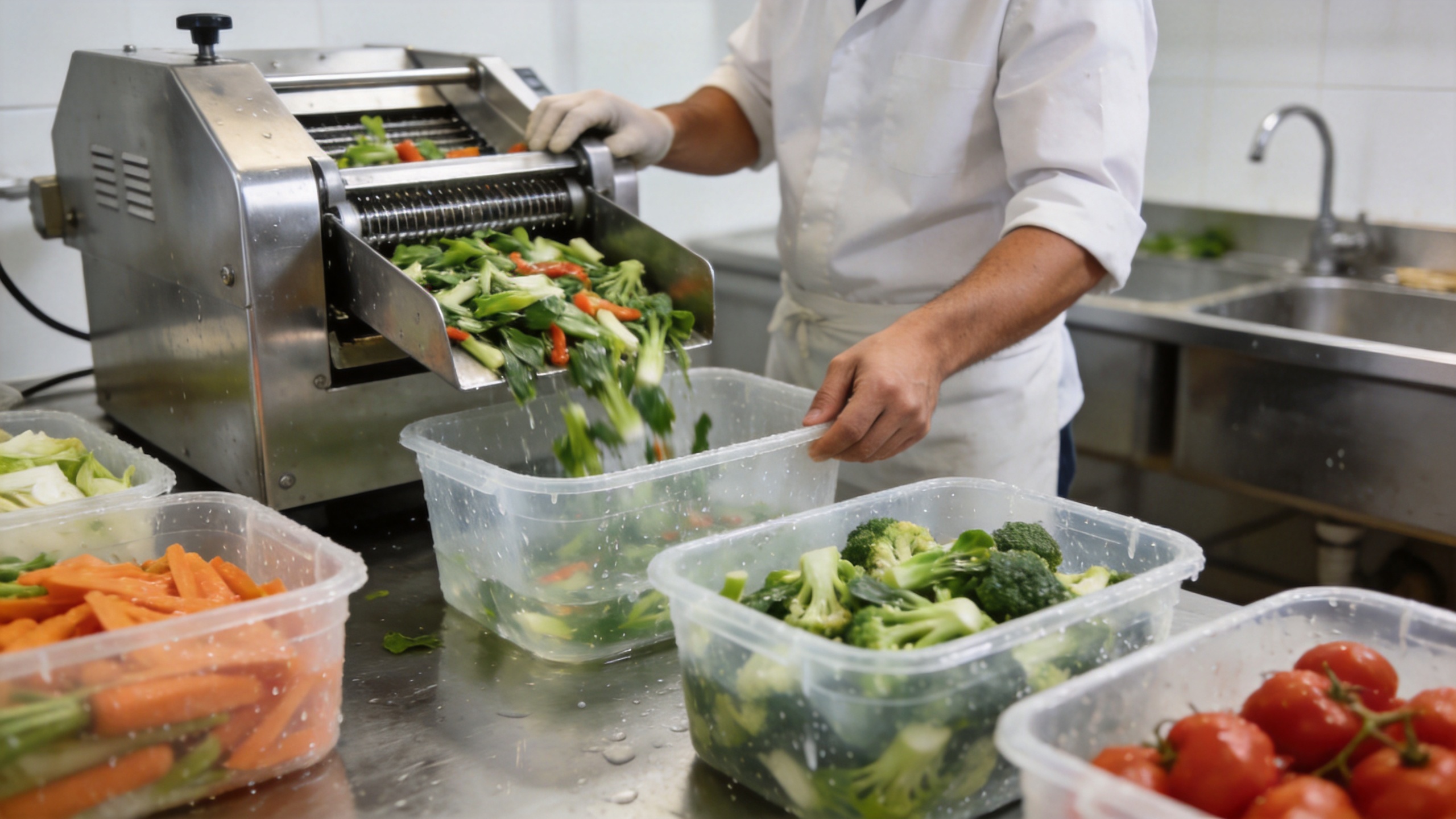
Many speed losses occur before or after the cutting chamber. If vegetables must be manually staged in small amounts, an operator may spend more time preparing each load than feeding the vegetable chopper machine. If discharge containers require frequent replacement, the machine can sit idle even though its cutting mechanism is ready.
Look at these practical flow checks:
- Is washed product close enough to the feed point to avoid repeated carrying?
- Can one person load safely and consistently without reaching across a busy aisle?
- Does the collection method suit the volume and cut format leaving the vegetable chopper machine?
- Can prepared product move promptly to weighing, packing, cooking, or the next approved process?
- Is there space for clean containers, used containers, and the operator’s normal movements?
These questions are not minor details. A smaller interruption repeated throughout a shift can shape total output more than an attractive stated capacity. In other words, a vegetable chopper machine supports speed when the surrounding work lets it keep moving safely.
Plan changeovers and cleaning as part of productive time
Food-prep planning should account for the time between batches, not only the time during a batch. When menus change, operators may need to change cutting components, clear product contact areas, clean accessible surfaces, inspect parts, and prepare the next ingredient. A vegetable chopper machine should therefore be reviewed with the site’s actual changeover frequency in mind.
Cleaning convenience is not a generic selling point; it is a workflow question. Ask which areas need routine attention, what access is needed, and how the manufacturer’s instructions align with the facility’s sanitation program. Plan enough room for safe cleaning and drying, and do not assume that a shorter cutting phase makes up for a complicated turnaround. For a multi-item central kitchen, a vegetable chopper machine that is straightforward to inspect and reset may fit the day better than a configuration chosen only for a peak moment.
Build an evaluation checklist for a vegetable chopper machine
A clear checklist helps purchasing, operations, and food-safety teams discuss the same requirements. It also helps avoid treating a vegetable chopper machine as an automatic answer to every prep problem.
| Area to confirm | Questions for the site and supplier |
|---|---|
| Ingredients | Which vegetables, sizes, and preparation conditions will be used most often? |
| Finished product | Which cut types are required, and how often will the operation switch among them? |
| Workflow | How will washed vegetables enter and how will cut product leave the vegetable chopper machine? |
| People and space | Who loads, clears, cleans, and checks the equipment, and is the layout workable? |
| Hygiene routine | What cleaning and inspection steps apply under the facility’s own documented procedures? |
| Verification | Can the proposed setup be reviewed using representative ingredients, target cuts, and an expected work sequence? |
Use a practical trial instead of relying on assumptions
The useful trial is not a race between machines. It is a review of a realistic batch. Bring representative vegetables where permitted, define the target cut, and describe the upstream and downstream stations. Then watch how the vegetable chopper machine is loaded, how product is collected, and what is required to move to the next task. Ask where the proposed configuration has limits rather than asking for a universal answer.
It is also helpful to list questions that remain open: Does the layout support continuous loading? Are personnel trained for the required operating and cleaning steps? Is the intended cut consistent with the actual ingredient condition? These questions make a request for information more useful and reduce the chance of selecting a vegetable chopper machine based on incomplete assumptions.
Turn faster prep into a repeatable routine
Improving prep speed is usually a matter of making a reliable sequence easier to repeat. Define ingredients and cuts, organize the feed and discharge path, allow for cleaning and changeover, and verify the configuration in the intended work context. A vegetable chopper machine can become a valuable part of that sequence when its use is matched to the product flow rather than separated from it.
Before requesting a configuration, prepare a short brief covering vegetable types, target cuts, expected batch pattern, available space, upstream washing, downstream handling, and sanitation requirements. That gives equipment discussions a concrete basis and keeps the focus on workable food-prep speed.