A commercial kitchen processing carrots, potatoes, onions, cabbage, and bell peppers in a single prep shift needs a vegetable cutting machine that switches between slicing, shredding, dicing, and julienne cutting without disrupting workflow. A single-function slicer handles one job well but creates equipment clutter and forces prep staff to move product between multiple stations. A multi-functional vegetable cutting machine consolidates these operations into one unit, but the variety of designs, cutting mechanisms, and claimed capabilities on the market makes selection challenging. Choosing the right model requires understanding the trade-offs between versatility, throughput, cut quality, and changeover speed.
The most common mistake buyers make when selecting a multi-functional vegetable cutting machine is being seduced by the total number of cutting configurations a machine offers rather than matching capabilities to actual menu requirements. A machine advertising fifteen different cut styles provides no practical advantage if your kitchen only uses four of them daily. Start by listing every vegetable your operation processes, the target cut specification for each, and the daily volume. Typical requirements include slicing potatoes at 3 to 5 millimeters for chips, shredding cabbage at 2 millimeters for coleslaw, dicing carrots into 6-millimeter cubes for soup bases, and julienning bell peppers at 3 millimeters for stir-fry dishes. If your menu changes seasonally, also note occasional requirements like slicing mushrooms or shredding cheese. This exercise produces a clear set of blade specifications: the slice thickness range, shred width, dice cube dimensions, and any specialty cuts. The right multi-functional vegetable cutting machine is the one that covers your actual cutting matrix with the fewest blade changes, not the one with the longest feature list.
Multi-functional vegetable cutting machines use one of three primary cutting mechanisms, each with distinct strengths. Disc-type cutters, represented by models such as the TS-Q323 and TS-Q80B, use interchangeable circular cutting discs mounted on a horizontal shaft. These machines excel at slicing and shredding operations and offer the fastest blade changeover, typically 30 to 60 seconds per disc swap. Their limitation is that they produce only two-dimensional cuts: slices and shreds, not cubes or julienne strips that require a secondary cross-cutting action. Belt-feed and pusher-type machines, including the TS-Q115B single-head and TS-Q118B dual-head cutters, feed vegetables through a hopper and past a rotating cutting assembly using a conveyor belt or pusher mechanism. These machines can produce a wider range of cut styles by combining different feed rates with different blade configurations, and the dual-head TS-Q118B can run two different cutting operations simultaneously, effectively giving the operator two machines in one footprint. Drum-type and rotary cutters, such as the TS-Q1500 and TS-Q311 vertical root vegetable cutters, are designed primarily for high-volume root vegetable processing. They can produce consistent dice cubes and french-fry strips at throughput rates exceeding 500 kilograms per hour, but they are specialized machines with limited flexibility for leafy vegetables or soft produce.
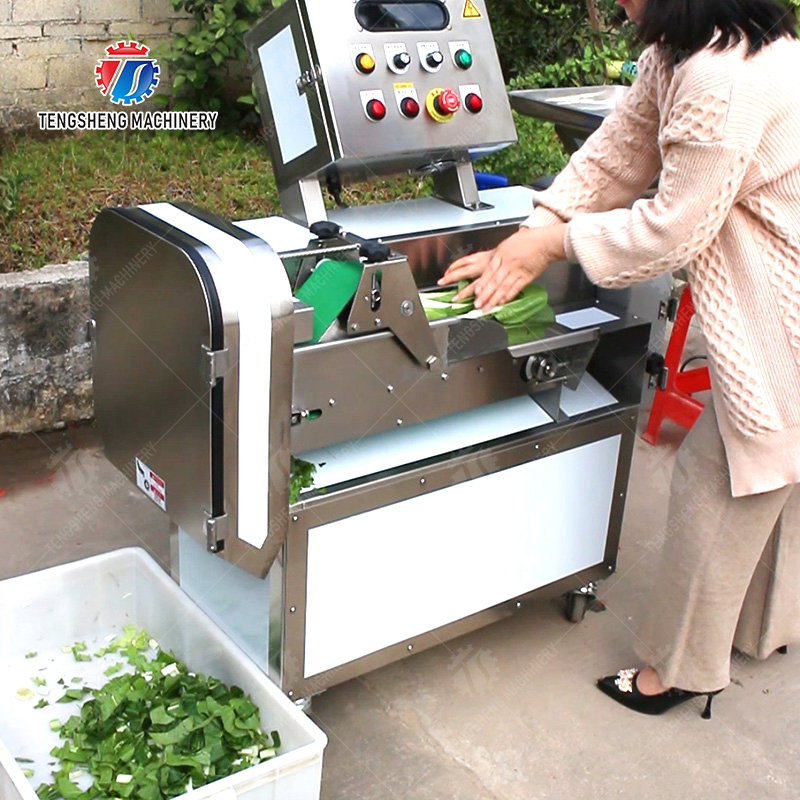
In a restaurant or central kitchen environment where prep windows are measured in hours, not shifts, the time required to switch a multi-functional vegetable cutting machine between cut styles directly affects how many menu items can be prepped within a given time block. A machine requiring ten minutes to disassemble, swap blades, and recalibrate between cutting operations creates a different workflow dynamic than one allowing tool-free changeover in under two minutes. The difference becomes critical when a kitchen needs to process five different vegetables with different cut specifications in a three-hour morning prep window. Machines with quick-release blade hubs, clearly labeled disc storage racks, and adjustment mechanisms that retain calibration settings between changes significantly reduce changeover friction. When evaluating machines, buyers should physically perform or watch a demonstration of a complete blade change cycle—from stopping the machine to producing the first acceptable cut in the new configuration—and time it. Manufacturers that have invested in user-centered design for their vegetable cutting machines, such as Zhaoqing Tengsheng Machinery Co., Ltd. with their tool-free blade access features on select TS-Q series models, reduce this friction as a deliberate design priority rather than an afterthought.
Cut quality from a multi-functional vegetable cutting machine depends on the interaction between three variables: blade sharpness, feed rate, and motor power. When the feed rate exceeds what the cutting assembly can cleanly process, vegetables are torn rather than cut, producing ragged edges that brown faster and cook unevenly. This typically happens when operators attempt to push product through faster than the machine's designed feed rate to increase throughput, or when a machine with an undersized motor is asked to process dense vegetables like raw sweet potatoes. A vegetable cutting machine rated at 0.75 kilowatts may struggle with continuous dicing of firm root vegetables at its maximum advertised throughput, while a 1.1 to 1.5 kilowatt motor maintains consistent blade speed under load. Buyers should request throughput data for their hardest and densest vegetables, not just the lightest and easiest ones, because manufacturer specifications often cite maximum throughput using ideal produce like peeled cucumbers rather than challenging materials like raw turnips or partially frozen carrots.
A multi-functional vegetable cutting machine is subject to intense daily use in a wet, acidic, and physically demanding environment. The cutting chamber, blade assemblies, feed mechanisms, and discharge areas are constantly exposed to vegetable juices, cleaning chemicals, and mechanical stress. Construction materials determine how well the machine withstands this environment over years of service. Food-grade 304 stainless steel for all product contact surfaces, including the cutting chamber interior, discharge chute, and collection tray, provides corrosion resistance and hygiene compliance. Aluminum components in these same areas will degrade and pit over time, creating surfaces that are progressively harder to sanitize. Blade assemblies should use hardened stainless steel with Rockwell hardness ratings appropriate to the cut type: shredding and julienne blades typically require 56 to 58 HRC for edge retention, while dicing blades that must maintain precise cube dimensions benefit from slightly harder ratings. The machine frame should be rigid enough to prevent flexing during operation, which can cause blade misalignment and uneven cuts. Welded stainless steel frames with reinforced mounting points provide the structural stability that bolted-together aluminum frames cannot match over extended use.
A meal prep kitchen producing approximately 800 portioned meals daily needed to process potatoes, sweet potatoes, carrots, zucchini, and bell peppers across four different cut specifications: 5-millimeter slices, 3-millimeter shreds, 8-millimeter dice, and 3-millimeter julienne strips. The kitchen initially used two single-function machines: a dedicated slicer and a separate shredder, with dicing and julienne cutting done by hand. This setup created workflow bottlenecks because the slicer sat idle while the shredder ran, and vice versa, while the hand-cutting station struggled to keep pace. After mapping daily cutting volumes and specifications, the kitchen selected a dual-head multi-functional vegetable cutting machine that allowed simultaneous slicing on one head and shredding on the other during the first two hours of prep, then a quick blade change to switch to dicing and julienne operations for the remaining vegetables. The result was a prep time reduction from approximately five hours to three hours for the same volume, with improved cut consistency eliminating the quality control step that had previously been needed to sort out irregular hand-cut pieces. The dual-head configuration proved particularly valuable because it allowed the kitchen to run high-volume slice and shred operations in parallel during peak prep hours rather than sequentially.
The purchase price of a multi-functional vegetable cutting machine ranges from approximately 2,000 dollars for a basic single-head disc-type unit to 8,000 dollars or more for a dual-head industrial machine with multiple blade sets and programmable controls. The financial justification depends on three factors: current labor costs for manual cutting, the variety of cut specifications required, and the volume processed. A restaurant spending 30 labor-hours per week on manual vegetable cutting at an average wage of 18 dollars per hour incurs approximately 28,000 dollars in annual cutting labor cost. A multi-functional vegetable cutting machine that reduces that labor by 60 percent saves roughly 16,800 dollars per year, recovering even an 8,000-dollar equipment investment in under six months. However, the calculation changes for operations that primarily need a single cut type at high volume. In that scenario, a dedicated high-speed slicer or dicer may deliver better throughput and lower cost than a multi-functional machine whose additional capabilities go unused. The key is matching the machine's flexibility to the operation's actual variety of cutting requirements, not paying for capabilities that will never be used.
Q: How many blade sets should I buy with a multi-functional vegetable cutting machine?
A: Purchase the blade sets that correspond to your daily cutting requirements plus one backup set for your highest-volume cut type. Blades dull faster on high-volume operations, and waiting for replacement blades to ship can halt production. Most manufacturers offer a-la-carte blade purchasing, so you can start with a core set of four to six blades and add specialty blades as your menu evolves.
Q: Can a multi-functional vegetable cutting machine handle leafy greens and hard root vegetables equally well?
A: Not necessarily. Disc-type and belt-feed machines handle leafy greens and soft vegetables well but may struggle with very hard root vegetables at maximum throughput. Conversely, drum-type and rotary cutters excel at root vegetables but can bruise or tear delicate greens. If your operation processes both categories in significant volumes, consider a dual-head machine that can be configured with different cutting assemblies optimized for each product type.
Q: What is the most overlooked feature when selecting a multi-functional vegetable cutting machine?
A: Noise level during operation. Many buyers focus on cut quality and throughput while overlooking that some vegetable cutting machines operate at 80 to 90 decibels, which requires hearing protection and disrupts kitchen communication. Belt-driven machines tend to run quieter than direct-gear-drive units, and some manufacturers publish noise specifications. If the machine will operate in an open kitchen or during service hours, prioritize models with documented noise levels below 75 decibels.

Copyright © 2024 Zhaoqing Tengsheng Machinery Co., Ltd all rights reserved - Privacy policy